Showing posts with label Wall Street Journal. Show all posts

Friday, November 13, 2015

20 Questions with Caroline Herrera

The Wall Street Journal's 20 Odd Questions interview this week was with Carolina Herrera.
Enjoy the interview below: 


VENEZUELAN BY BIRTH but a New Yorker at heart, Carolina Herrera belongs to an unusual class of fashion designers as well versed in manners, decorating and entertaining as they are on what a woman should wear.
Mrs. Herrera, 76, may prefer traditions to trends, but she isn’t stuffy. Even as she decries, say, older women in shorts or phones in restaurants, she does so with the glint of a playful smile. And with her own style—trim pencil skirts, crisp white shirts, not a hair out of place—the designer exemplifies how to be elegant.

That look has attracted many, including late photographer Robert Mapplethorpe, for whom she’s posed several times—after a bit of convincing. (She dislikes having her picture taken.) One of those photos, from 1979, currently hangs in the Smithsonian’s National Portrait Gallery, in Washington, D.C., where, on Nov. 15, Ms. Herrera will be honored with a “Portrait of a Nation” prize, which recognizes the achievements of individuals depicted in its collection. We recently chatted with her about her youthful desire to smolder á la Garbo and the frumpiness epidemic in airports. 

The first thing I ever designed was:
A black dress, for myself, when I was 14 or 15. I wanted to be a vamp since I started watching movies from the 1930s and ’40s with Marlene Dietrich and Greta Garbo, where they wore veils and hats and carried cigarette holders. My parents never allowed me to wear the dress after I made it.

Every morning:
I take a walk in the [Central Park] Reservoir for one hour. I wear tennis shoes but not exaggerated ones. I wear Keds. 

I never leave the house without:
Lipstick. When I have it on, I feel perfect. I used to like one from Bobbi Brown, then she stopped producing it. When I told her I wanted it back, she created it for me and called it “Carolina.” I think it sells very well now.

I have my breakfast:
In bed with my dog by my side. He has his own food, but I always give him a little something.

Fashion is all about:
Proportion. It has to be perfect. For example, the platform or wedge shoe looks good on a long leg, but terrible on a short leg.

One thing I wear every day is:
My Verdura watch from the ’40s. But this summer, when traveling in Italy, I wore the most beautiful white Swatch. It was divine. You can do whatever you want and not be afraid someone will steal it.

My fashion pet peeve is:
How people dress at the airport. It’s terrible. You know, if you dress up at the airport you will actually be taken care of perfectly. You’ll be the one who the stewards look after the most.

I organize my closet with:
All the skirts together, blouses together, evening together, same lengths together, all the same hangers.

The last white shirt I bought is from:
 Azzedine Alaïa. But my favorites are from Patrick Robinson when he worked at Gap. They’re washed by hand, with a little bit of starch. I always monogram them, too. 

When a bride asks for made-to-order dresses, I insist:
That she come alone. If a girl comes in with her family and best friend she lets them influence her too much. It’s one of the most important days in her life. She should be able to wear what she wants.

The secret to aging gracefully is:
Knowing what looks good on you at all ages. If you try to dress in a young way when you’re old, you’re going to look even older. Shorts, for example, are for young people with lovely legs.

I entrust my beauty regimen to: 
[Prominent dermatologist] Pat Wexler. It’s not my secret, but it’s the secret of many women who don’t say “hi” to her when they see her in the street.

I don’t eat:
Junk food. If someone puts potato chips in front of me, I’ll probably eat a little, but I’m not one of those people who goes to buy them.

My favorite restaurants in New York are:
La Grenouille and Indochine. La Grenouille is the more beautiful; it’s like being in a garden, full of flowers. It’s a civilized place where you can have a conversation.

I am a maniac about:
Setting tables and making beds. Both have to be perfect, my mother taught me that. I like linens from Schweitzer, D. Porthault or Pratesi.

My favorite hotel is:
The Ritz in Madrid. I’ve been going there for 50 years and it’s like a second home to me. It’s very classic; the service is impeccable.

My obsession of the moment is:
Netflix. I’ve been watching “Scandal” and a British series called “Midsomer Murders.”

I’m currently reading:
 Edna O’Brien’s book of short stories, “The Love Object.” It’s so good! I like to read, it’s one of the things I do to distract myself.

One downside to digital 21st-century life is:
There’s no privacy. I don’t mind if someone asks me to take a picture; it’s flattering. I tell them, “The photograph, yes, but the arm around me? No, please!” It’s invasive.

—J.J. Martin is the founder of retail website LaDoubleJ and the designer of LaDoubleJ Editions.


Follow Twirling Clare: Facebook//Instagram//Pinterest//Tumblr//Twitter

Monday, June 1, 2015

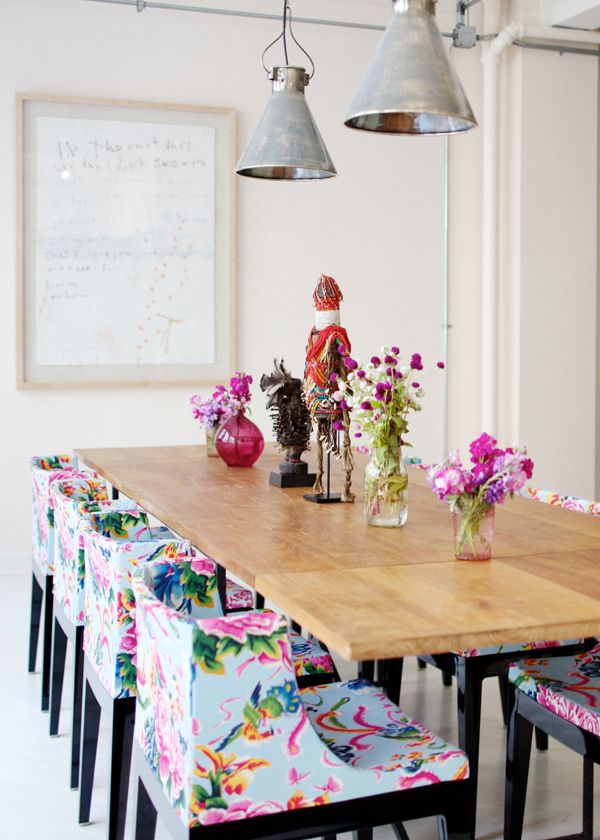
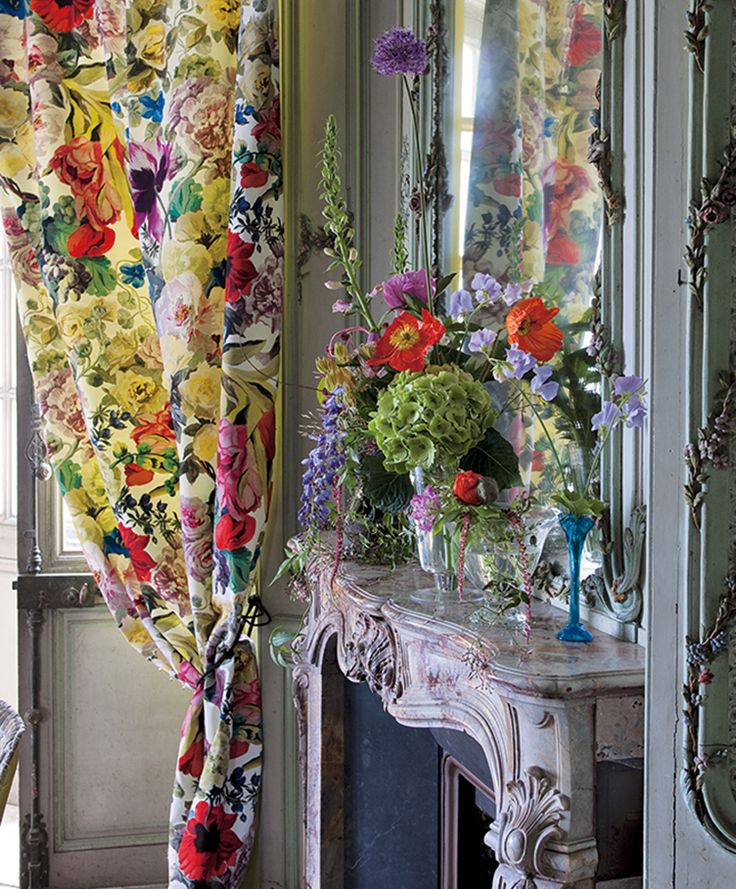
A Turbocharged Take on Traditional Florals

Last week I read a great article in The Wall Street Journal about the reinvigoration of florals in the interior space. While popular throughout different decades, the dominant trend in recent years has focused on Pottery Barn oatmeal and Restoration Hardware grey, both of which are - in my humble opinion - utterly dull.
If you didn't need a reason to be inspired by adding florals (or just simply color) to your home, this quote is my favorite from the article, "There is nothing happier, more vibrant, nostalgic...and passionate, than a dramatic floral. It's an instant mood elevator."
Regardless of how long you might have been following Twirling Clare, it's probably not too hard to gauge that I'd prefer the eccentric whimsicality of Dorothy Draper over subdued earth tones; an interior style on par with Traditional Home and Veranda.
Both my mom and my grandma have a great eye for interiors, favoring beautiful fabrics, bright colors and classic, traditional furnishings and I have definitely adapted a similar preference and taste in regards to interiors. So, naturally, this piece caught my eye!
The entire WSJ article is below for you to read. Regardless if you're a fan of having flower blosoms on your wall or not, I'd recommend reading - it offers a really interesting history on some of the great print designers today, including Liberty and Laura Ashley, while also featuring top deisgners from the nation's most eponymous design firms.  

The Wall Street Journal - "Decorating with Amped-Up Floral Patterns"
by: David A. Keeps


When Designers Jason Oliver Nixon and John Loecke, creators of the Madcap Cottage decor brand, decided to refresh their 1840s upstate New York home, they made an uncoventionally conventional choice: a turbocharged take on traditional florals. They covered walls in an extroverted peony-print wallpaper, upholstered furniture in fabric crowned with gregarious geraniums and hung drapes whose "stripes" were formed by a regiment of roses. This bouquet of florals all came from Laura Ashley, the British fabric and wallpaper firm that dominated American decorating during the heyday of "Little House on the Prairie" and Ralph Lauren denim skirts.
But these patterns deviate from the demure Laura Ashley look of the 1970s. "Laura Ashley brought an English country sensibility to American design," said Mr. Nixon of the firm's original florals. "Now they are changing the scale, tweaking colors and backgrounds and creating patterns that have a more painterly, organic feel." The refreshing results, he added, are a "terrific tonic for [Americans'] hectic schedules and hyper-technological world."
With all the attention being paid to heritage brands, it's perhaps unsurprising that, after 60+ year, Laura Ashley has become revitalized. With 450 retail stores around the world, a hotel in England's Lake District and a new U.S. website, the design house is re-engaging those who grew up with it as children in the 1970s and 80s. Its rebirth is arguably part of a movement. Decorators have lately been referencing gusty floral interiors - Doroty Draper's Greenbrier Hotel, Diana Vreeland's red "garden in hell" living room - and embracing bold flowery prints by other storied fabric houses including Pierre Frey, Rose Cumming and Liberty of London, which launched a new Interiors Collection this January in Paris.  
"We continually pull from our history, but do it in new ways," said Penne Cairoli, President of Laura Ashley. "Our signature florals have grown from ditsy-small to oversized designs, and we've added new colorations like amethyst, chamomile and duck egg."
"All the top-end British companies are pushing boundaries," said Liberty Interiors Head of Design, Emma Mawston, of this newly designed, hand-drawn pattern."Currently there is a real value for large botantical creations."
"There's nothing happier, more vibrant, nostalgic...and passionate, than a dramatic floral. It's an instant mood elevator," said designer Sasha Emerson, who prefers patters where retro meets modernism."Rose Cumming's use of florals was always restrained," said Chuck Comeau, President of Dessin Fournir.
But if these florals don't exactly sync with old-school Laura Ashley delicacy, neither are they the mod, graphic, stylized blossoms of Marimekko, Lilly Pulitzer and a host of contemporary design houses. Rather, despite a bump-up in the scale and color of many patterns, they represent the more intricately naturalistic 19th-and early-20th century floral renderings found on vintage wallpapers and chintz, a glazed-cotton fabric that was last seriosly in vogue when Anna Wintour declared it so as the editor of House and Garden in the late 1980s.
The New York design firm Tilton Fenwick has dubbed the look 'granny chic.' "We are trained in very traditional design and are admirers of some of the most classic floral patterns," said co-owner Suysel dePedro Cunningham. In a range of projects, including its own offices, the firm is using historical fabrics in line with the new Miracle-Gro aesthetic, such as Pierre Frey's Le Grand Corail (designed in the mid-1800s by the firm Braquenie), an oversized floral featuring thick, virile stalks and blooms as big as cabbages. "In our design work, we can't think of a place where we wouldn't use floral prints," Ms. Cunningham added. "Walls, headboards, even lampshades."
The appeal, even to those who are not deprived of flowers by drought, is plain. "Post-recession, people are suffering from frugal fatique. They want something joyful and happy," said Los Angeles designer Kathleen Di Paolo, who grew up in a room "that was decorated top to bottom in forest green Laura Ashley fabrics." That company's new bigger, brighter floral prints triggered nostalgia," she added, "but it's a nod to the past with a modern flair."
Indeed, with advances of digital printing, "floral prints can be offered in new, exciting looks that a younger generation identifies as theirs," said Libery Interiors Head of Design, Emma Mawston. Trading on its vast archives, which include prints by William Morris, the master of the British Arts and Crafts movemnent in the late 1800s, Liberty fabrics have been retooled (and in some cases magnified or designed from scratch) for 21st-century interiors, said Thomas Lavin, who represents the collection at his showrooms in Los Angeles and Laguna Beach.
Not every traditional fabric house is revamping its offerings, however; prints by Rose Cumming, the groundbreaking decorator who took Manhattan by storm in the 1920s, have also been overscale. "They're timeless and convey a sense of elegance that's hard to replicate," said Chuck Comeau, President of Dessin Fournir, which in 2005 acquired Ms. Cummings floral designs. He said that younger generations, who came of age in a time of minimalism and stark modernism, are particularly responding to the prints.
Updated or not, oversized florals can be used in new ways that "move the design needle forward," said Mr. Nixon who drafts both period settings and clean-lined contemporary spaces, often as upholstery to breathe new life into antiques and midcentury furniture.
But unless you're Mario Buatta, New York-based designer and self-proclaimed Price of Chintz, be careful not to overdo it. "Mix florals with stripes and solids, and play with scale," Los Angeles interior deisgner Sasha Emerson advised. "I would never do a whole room in the same pattern. But, I might wallpaper an entire room in a crazy floral, go very modern with the furnishings, throw in a Noguchi lantern and call it a day."

Tuesday, November 4, 2014

Is This the Beginning of the End for Skinny Jeans? - WSJ

For nearly a decade, skinny jeans have ruled the fashion world. Even for regions a little bit behind the eight-ball on some of these trends (the Midwest), the look has still had a pretty strong 6-year run. I have worked at a boutique for over three years and throughout my entire time at the store, it has always been "skinny jeans, skinny black pants, super skinny, etc." 
When I wear skinny pants, I prefer having a long blazer, cape, or trench coat to complete the look. I feel that's the most polished way to style. Even when I went through my leggings phase in college, I tried to incorporate some of the same pieces (coats, button downs, etc.) to make me feel more put-together - with the understanding that I wasn't wearing pants...
The entire fashion industry has morphed to accommodate for the style. Oversized sweaters, long blouses, billowy tanks - the problem? it's hard to find tops made to be worn with anything other than skinny pants. When customers ask for recommendations on how to style a top we have in our store, skinny pants is always the go-to...granted, I try and provide other recommendations as well. But skinny pants are the staple and designers have created tops to work with that look. 
Lately, I have gotten sick and tired of seeing people in super skinny pants because, at risk of offending anyone, a lot of people do not style skinny pants in a flattering way and it's just not a good look... 
There are many other fashion options that I think can be more flattering, but they're just not available. Although today's industry has more selections for dressing than ever before, sometimes it's hard to find other options and have the confidence to wear them. 
I am ready/have been ready for a fashion industry change for a long time. And there seems to finally be a little wake-up call. 
Throughout this year's September fashion week, fashion blogger Man Repeller wore straight legged distressed denim almost everyday. I had a feeling she'd be one of the instrumental influencers in crafting a new look and it appears she helped move the needle. While this particular denim look might not be the most flattering option (if such a thing can exist in the denim category) - it still will cause some must-needed disruption. Everything in life needs a little change and I think we're long overdue for an update. 
I will probably still wear skinny pants for many occasions, as I think they do look great paired with certain pieces, but I am excited to see people trying something else! Personally, I think the looks below have a more sophisticated flair (wider-legged pants with tucked-in blouses) than a lot of what we have seen lately....any thoughts?

This past weekend, The Wall Street Journal had a great editorial on the new wave of denim. Read the complete piece below. 

High-waisted, faded and decidedly not skinny, an unlikely new style of jeans—often inspired by Levi's classic 501s—is being adopted by the most fashionable women.


On the final day of Paris fashion week in October, art director Sofia Sanchez Barrenechea wore what she had habitually referred to as her “crappy jeans”—old Levi’s, which she bought at a vintage store. Somehow, that day, they felt crappy no more. Pairing them with a structured crop-top, low-heeled boots and a polished handbag, she achieved a look that could survive even the French fashion gauntlet. “I started feeling like I could pull them off,” said Ms Sanchez Barrenechea.

No doubt. In the past few months, many women on the leading edge of the fashion curve have been seeking out vintage (or vintage-looking) denim that’s derived largely from Levi’s iconic straight-leg, long-rise and pale wash 501 style—last popular in the 1990s. Even Vogue Paris editor Emmanuelle Alt recently wore looser, straight-leg, faded jeans—a shift away from her signature skinny crop.

“It does feel new after a decade of skinny jeans,” said Laurie Trott, fashion editorial director of e-commerce site Piperlime, who’s been living in a pair of vintage Levi’s 505s—a straight-leg fit with a slightly lower rise than 501s—that she had tapered by a tailor. Ms. Trott wears them with Thom Browne for Brooks Brothers button-downs and low-heeled sandals. With such an otherwise tomboyish look, she said, “I like a high-waisted silhouette. It shows I have a waist and hips.”

The new direction is part of the natural cycle of fashion, when the pendulum inevitably swings away from a supremely popular style. Florence Kane and Jane Herman Bishop, founders of the denim blog Jean Stories, think the preference for the newly chic classic jeans over the ubiquitous “jegging” lies in individuality. “You don’t want to wear the same black skinny as everyone else in your office or all of your friends,” said Ms. Herman Bishop, whose favorite jeans are currently an old Japanese pair she found at Los Angeles vintage shop Mister Freedom and had altered at Denim Revival, a company that specializes in jean reconstruction.
And if that means adopting clothing that once belonged to somebody else, so be it. “Each [vintage] pair has a story because someone before you has worn them in a certain way or tailored them in a certain way,” said stylist Vanessa Traina Snow, who has a few pairs of vintage jeans, including her mother Danielle Steel’s old 501s. (“I mean, they really are ‘mom jeans,’ ” she joked.) She wears them elegantly with an oversize Céline sweater and pointy Manolo Blahnik pumps.
Since few women have the patience to sift through piles of used clothes, people like Ms. Traina Snow are doing it for them. Recently, the Line, the e-commerce site she co-founded, partnered with Manhattan vintage shop What Goes Around Comes Around to offer a selection of vintage jeans. The online inventory of Levi’s 501s was quickly snatched up, but you can find a similar faded, five-pocket style by 6397, a two-year-old denim brand, on the site.
At the more mainstream end of the retail spectrum, Urban Outfitters’ Urban Renewal website features decades-old denim selected from dead-stock by its buyers. A pair of generously cut French workwear jeans is available for $398, for instance, but Jean Stories’ Ms. Kane recently snagged a pair of Levi’s 517s—a high-rise, boot-cut style—on the site at a more accessible price. “I’m a very lazy vintage- jeans shopper,” said Ms. Kane, who came across the site while working late one night. She wears her 517s with black pumps for meetings or flat loafers for a casually chic American-sportswear feel.
Other denim brands are also looking to fill the need. Denim behemoth Citizens of Humanity has a faux-old Premium Vintage collection whose slouchy boyfriend-fits might please a 501-fixated shopper. The line's women's creative director Catherine Ryu scours Tokyo thrift shop BerBer Jin, which has a huge denim stock, for ideas to keep things authentic.
Some upstarts are getting in on the action as well. AMO, a label launching next spring, started by industry vets Kelly Urban and Misty Zollars, will offer five old-school styles with updated touches like a pitched-forward side seam that slims and lengthens the leg. "We wanted to create something that didn't exist - something that looked vintage and cool, but fit a woman's body," said Ms. Zollars. "We picked the fabric because it literally looks like the Levi's 501s we're obsessed with. It's an open weave with beautiful twill and a shade of pure indigo."
For all that work, the jeans are still priced the same as your skinny, spandex-boosted Acnes and J Brands - between $200 and $300, but 100% cotton jeans like Re/Dun's or great vintage scores may be a better buy. Stretch denim will eventually sag, and any tears will curl up, not artfully shred and fray. And with high-waist and looser leg, you don't necessarily require that body-hugging, stick-to-your-hips stretch factor. Meanwhile, Re/Dun, a brand started by Sean Barron, who co-founded Joie, and Jamie Mazur, who founded denim flash sale company Underground Denim, also strikes a balance between vintage and new. Messrs, Barron and Mazur source old jeans from private dealers - anything with paint splatters and distinctive nicks or fades ranks highly - then resew the fabric into one of three contemporary (read: not quite so retro and high-waisted) silhouettes: "relaxed skinny," relaxed straight," and "repaired," which "look like someone's grandmother mended them at home with another piece of denim, thread and a needle," said Mr. Barron. 
"The skinny was designed to de-accentuate the butt, to make it look smaller and narrower," said Jean Stories' Ms. Kane. "I think now women are not afraid to accentuate their behinds, and real denim is going to do that. It's a really nice change,"
Levi’s has shrewdly taken note of the kicked-up demand for these styles. (This isn’t the first time. The brand launched its Levi’s Vintage Clothing program, in 1996, with reissues of 501s because the jeans were so sought after then.) In January, as part of its main collection, the company will introduce the 501CT, with a slightly narrowed—but not-skinny—leg. “Tapering was the second most requested alteration, second only to shortening,” said Levi’s senior vice president of global design, Jonathan Cheung. “It’s almost as if we crowdfunded the design.”

Tuesday, July 16, 2013

To Grandmother's Style We Go

Regardless if you know me beyond the pages of my blog or not, I am sure you have gathered that I am a fairly traditional, modest, and classic dresser.
I cite the beginning of my personal style dress code when I was 12 years old. I hated shopping, leaving my mom to pick out clothes for me. I detested shopping so much that when my L.L.Bean khakis grew too short, but fit in the waist (I wish that was still a problem!), I wore them nevertheless. I paired my "ankle length" pants with a white tee, sweater tied around my neck, drivers mocs, a trio of gold bangles, and a colorful ribbon belt. The look only changed in the summer months when I substituted pants for boy's khaki shorts.

I have become a bit trendier since my junior high and early high school days. My wardrobe has expanded, I have diversified my collection...but I still cite the same inspiration.
I have always striven to be a timeless dresser. I want to wear things that I can have for years and years to come. I want to look effortlessly chic, at any age, and I have sought much inspiration from women decades older.

I think that my Grandmas, both deceased, had tremendous style sense. Today is the one year anniversary of my Grandma's passing...and I think recognizing the inspiration both matriarchs of my family had on my style (and life) couldn't come at a better time.

My Grandmother's had different personalities, were from different regions...and, fittingly so, had different dress codes (although similar in their timeless nature).

My Grandma lived in Cincinnati her whole life, spent time working at a flower shop, drove around in her cadillac, played cards, and was my favorite couch-chat buddy. She was a fan of pastels, festive reading glasses, broaches...and no one looked better in a St. John's suit.

My Grammy lived in Maryland, raised five boys, took painting lessons, and had a larger than life personality...drawing attention and interest wherever she went. She was quintessentially prep. Monogram sweaters, espadrilles, headbands, and in true prep fashion...she pulled it all off effortlessly.

Both have influenced my style more than anyone else.

Although I will go through periods where I my inspiration sources vary form the likes of: a lady shopping at an art museum gift shop, a woman walking her dog on the rocky beaches of Maine, or a madam preparing for a gala reception; my grandmothers remain my primary "style icons". 

 Several weeks ago, my dad came across the article "Gran Larceny" from the Wall Street Journal. The editorial argues that rebellion in the fashion industry is actually shopping your grandmother's closet, believing that more is less, and that looking beautiful is far more valuable than looking sexy. 

Even though I have been embodying this trend for half of my life, I don't plan on changing anything too soon. 

Below you can find the article by Alexa Brazilian.

I'd love to know what you think:


"IS CONSERVATIVE THE new radical? The fashion world certainly seems to think so. This season, designers filled their runways with restrained silhouettes that echo the graceful, showing-less-is-more aesthetic of generations past.
Designers are reimagining soignée staples for spring and summer—skirt suits, twin sets, below-the-knee dresses, kitten heels and frame bags—that appear anything but moth-eaten. In fact, fashion's neoconservative coup d'état feels deliciously defiant, given the excessively revealing styles pop culture celebrates. A quick flip through any supermarket tabloid yields an onslaught of oversexed stars and their indelicate fashion choices, which prompted a strict dress code for this year's Grammy Awards. When you factor in over-the-top street style and the all-round oversharing that has become pervasive, the reeled-in restraint of a bygone era looks more and more like a cool, quiet revolution.
This dignified uprising can be spotted on many of today's most influential style setters—British fashion icon Alexa Chung, Russian supermodel Natalia Vodianova and Moda Operandi co-founder Lauren Santo Domingo, to name a few.
"A young girl now doesn't want to dress like her mother; she finds her grandmother much cooler," said Nina Ricci creative director Peter Copping, who designed skirt suits inspired by his own nana. "She wore little smart, tweedy suits. I always had a romantic notion of that." But the designer, who modernized his separates by cutting them in a light-as-air bouclé woven onto organza, also drew inspiration from a much younger source. "Someone told me a story about the [22-year-old] model Eliza Cummings and how when she got her first big money job she went straight out and bought a Chanel suit," said Mr. Copping. "I thought, 'Wow, that's really clued up!' "
In his spring collection, Bottega Veneta designer Tomas Maier, who has long imprinted the brand with a classic femininity, crafted sheer cardigans, calf-grazing dresses and a coat in the sort of rose print one might find on the walls of a '50s-era powder room. "I never liked the obvious definition of 'sexy,' " said Mr. Maier. "I actually don't even like the word. I prefer a woman to be sensuous and in charge—definitely in charge of what she's wearing."
Twenty-six-year-old designer Wes Gordon agreed. "In serious times, you need serious chic. Anything cute feels bad right now. A grown-up, covered-up silhouette is the anti-cute," said Mr. Gordon, whose signature long-sleeve gowns and full skirts have been worn by bright young things such as Jessica Biel and Rita Ora. His spring collection had a red skirt suit worthy of Nancy Reagan. Among Mr. Gordon's inspirations: a book of Valentino Garavani's designs from the '70s (the house's current designers, Maria Grazia Chiuri and Pier Paolo Piccioli, are also huge proponents of the conservative-but-cool look) and Greta Garbo. "But late Garbo, when she was running around New York City with a popped collar, hiding from people," he said. "It's good to be a little mysterious in the overcrowded, overexposed world we live in now."
"What feels new is being a bit quieter and more discerning."
Even London's resident bad boy Christopher Kane is of a similar mind. "Ladylike is the ultimate sexiness," said the designer. "It's clean, elegant and in control. The famous saying, 'It's the quiet ones you need to watch,' definitely applies to this style."
Although the movement centers on mature silhouettes, it's the accessories that carry it over into phenomenon territory. From the delicate stampede of pointy kitten heels and sensible block-heeled sandals to the flood of frame bags and collar-grazing necklaces, little touches are capable of creating big changes in attitude.
"There is a shift in sensibility happening now—shoppers are moving away from conspicuous It-bags, the vertiginous platform heel and gaudy in-your-face jewels," said Kate Davidson Hudson, co-founder of the newly launched accessories shopping site Editorialist. "What feels new is being a bit quieter and more discerning—having your subtle gold studs, cat-eye glasses, proper box bag and most importantly, the mid-heel shoe.
"Indeed, low-riding heels—from Louis Vuitton's Magic Square pumps to Miu Miu's squat, crystal-encrusted patent-leather numbers—have been star sellers for spring. There has also been an attendant uptick in popularity for the shoe brands that your grandmother and great-grandmother loved. Roger Vivier, the brand known for its low, pilgrim-buckle pump made famous by Catherine Deneuve in "Belle de Jour," seems more popular than ever, both for its shoes and the book on its 75-plus-year history released last month with publisher Rizzoli. Ferragamo, another perennial ladies-who-lunch favorite, is celebrating the 35th anniversary of the Vara, its sweetly iconic gold bow-topped shoe, with a new campaign featuring of-the-moment women such as Ms. Santo Domingo and Chiara Clemente wearing the classic, dainty-heeled slippers. As of this month, they can be customized to one's liking on the brand's website with a choice of color combinations and materials, and the option to monogram the soles.
One longtime Ferragamo Vara fan is Ms. Chung. "I think one of the first times I was photographed, I literally sneaked into a Topshop [fashion] show and I was wearing a cardigan, some white tights and Ferragamo heels," recalled Ms. Chung, host of the music TV show Fuse News on the Fuse channel, and author of "It," a book on her personal style and inspirations (out from Penguin in late October).
She's also emblematic of a certain brand of young-fogy dressing that has become popular with the next generation of taste-makers, including 27-year-old sister-designers Mary-Kate and Ashley Olsen, whose discreetly polished and structured bag designs for their label The Row have become industry favorites."

Follow Twirling Clare: Facebook//Instagram//Pinterest//Tumblr//Twitter
Related Posts Plugin for WordPress, Blogger...